Posted in Classroom Examples

How do I incorporate inquiry, innovation and all that other stuff they want me to bring into my classroom?

what-can-i-do

We have all been to a conference or listened to a speaker that has inspired us to do things differently in our classroom, but when we get back to school the reality of curriculum, class sizes and marks get in our way…right?  As well, there has been a ton of discussion about the fact that education needs to change, but when discussing this with teachers who are interested, often the question is how do I do that? In my next few posts I would like to share with those who are interested in what I am doing to change the way we do things.  Maybe you are interested but just not quite sure where to start.  To be honest, I have taken bits and pieces from all kinds of amazing educators to make my classroom more innovative and authentic, but still my own, and I would like to share that with anyone who is interested.  Please feel free to contact me if you have any questions along the way 🙂

 Inquiry, Student Choice and Passion where it all came from….

I came across this video about 5 years ago and I knew I had to do something like this in my classroom.  I started by teaching my students in a very traditional way about a particular unit. For example World War II in history or Anthropology or a certain age group in the Human Growth and Development and then I would let the students choose a topic that they were interested in.  We would use the Social Scientific Research Method to learn about it and then at the end of the “Inquiry” they would be asked to showcase what they had learned in any way that they wanted. I created one rubric that would that would assess all projects. It was great, it allowed students to choose the topics that they really want to look into, but my students were still very much in school mode when they finished their inquiries and what I was hoping for was not really being achieved.  Yes, they got to choose what they wanted to learn, but we just continued to complete projects like we would have before. So I continued to read about what others out there were doing and we added to the process. As of right now the steps that I have taken are below.  It has evolved so much that I plan to describe each step below in its own blog post.  

  1. Enlighten them!!  I teach them about unlearning, about what is wrong with the current system and show them that we need to change in order to prepare them for the real world.  This prepares them for their unlearning process.
  2. Social Media:  Teach them about the power of Social Media – create twitter accounts for them to use throughout the semester.
  3. Curriculum:  Expose students to course curriculum in the first two weeks of the course.
  4. Self Direction:  Teach them how to complete the inquiry process (See steps below).
  5. Model:  Practice one together.  
  6. Gor For it!!  For the semester: complete inquiries and action plans, genius hour, field trips, connect with real people, invite guests in, raise awareness, try and go viral, make a difference, learn with purpose.
  7. Assessment:  Reflect on the process.
  8. Showcase it:  At the end of the semester each student is asked to attend our Social Science Fair where they showcase what they have learned and connect their process to our OCDSB Exit Outcomes (Essential Life Skills).  We invite people from the community such as the Mayor, Councillors, Parents, Grandparents – our goal is to get Justin Trudeau and the media to make it out to our next one!!

How my courses work

Below is the course layout that I have used over the last couple of years no matter what class I was teaching.  Each time I come across something new I try to incorporate it into what I am doing, therefore the classes are always evolving.  

Grade 10 & 11 syllabus for the semester:

  1. Inquiry # 1 – Goal Create awareness
  2. Inquiry # 2 – Goal same as above + create a Solution
  3. Action Plan – What do you want to learn, how would you like to learn it, what will you do with the information once you have learned it?
  4. Twitter
  5. Genius Hour
  6. Social Science Fair

 Inquiry Steps:

  • Choose a current issue – something that you are passionate about, could be passionate about, that you are already involved in, etc.
  • Learn about the current issue and become and advocate for it.
  • Create a media piece to gain attention, followers etc. post it – over and over and over to get tracktion
  • Use the Social Scientific Method to research your issue in relation to your course material.
  • Campaign:  As you research tweet out, and at people who care about your issue – connect with organizations and classmates. Try to get on the twitter pyramid.
  • Ultimate Goal – get noticed, get your message out there, create a solution – do something that matters.
  • Assessment – students are assessed on a biweekly basis via twitter, each student reflects at the end of each inquiry and give themselves next steps for their next one.


Grade 12s

  1. Action Plan – What do you want to learn, how do you want to learn it and what will you DO once you have learned it?
  2. Group Action Plan
  3. Weekly Discussions
  4. Social Media
  5. Barrhaven BIG
  6. Genius Hour
  7. Other
  8. Social Science Fair

In the grade 12 class the students get a lot more freedom and choice.  Most students that I have in my classes have gone through at least one class in grade 10 or 11 with me and have started their unlearning process.  I will go into more detail in a later post.

Thanks for reading and I look forward to sharing and learning from all of you!!

Cheers,

R

Posted in Why Unlearn?

What exactly is Unlearning?

unlearn a toffer

In my first few posts I have tried to explain what I feel is wrong with our current education system, and hopefully I have got some of your attention.  I truly believe that society, teachers, parents and students need to unlearn the current system, but what exactly is unlearning? Before we can define unlearning, we will need to define what it is that we need to unlearn, school, the role of teacher and student.  

What does it mean to be a teacher?

In a traditional sense it means that they are the keeper of knowledge, they are the ones that tell students what they need to know and how to learn it.  This was a great model for the industrial age and maybe for a couple of centuries to follow. But it is outdated, and does not prepare students for the world that they will live in.   In Peter Gamwell’s book Wonderwall, he suggests that we live in an age of complexity, that we no longer need to spit out carbon copies of students who know the same stuff. Don Wettrick points out that in a few years 40% of jobs will be made up by the “Gig” economy, and that students will need to be able to solve problems by being innovative and creative.

“A gig economy is an environment in which temporary positions are common and organizations contract with independent workers for short-term engagements. The trend toward a gig economy has begun. A study by Intuit predicted that by 2020, 40 percent of American workers would be independent contractors.”  (techtarget.com)

What does it mean to be a student?

For the past 200 years students have been consumers of knowledge.  They learn whatever they are being taught and then regurgitate it to prove that they know it. Usually they have very little control over what they learn and how they learn it.

Some responses to the need for change.

Don’t get me wrong, there have been a lot of initiatives to change student engagement throughout my teaching career.  Even though there are things that still resemble the industrial revolution (bells and rows) teachers are doing amazing things to deliver content in a more engaging way. We’ve learned about different types of learners and implemented better ways for these students to learn (kinesthetic, audio, visual etc), we’ve used differentiated instruction, classrooms have been equipped with the latest technology such as smart boards, ipads, chromebooks and more recently we have been implementing more inquiry into our classes.  This is all a great start, and some of these methods should remain, but it is not enough, we need to redefine the traditional student / teacher roles as well as the definition of the traditional classroom. The classroom walls need to come down. We need to wipe the slate clean and start fresh so that our schools resemble the world in which our students will be living.  Students need to become creators rather than consumers and teachers need to become mentors / facilitators.

So what exactly is unlearning?

I enjoy change, actually I thrive on it.  I have never taught a class the same way more than once.  I am constantly looking for some way to change things up and do a better job.  I reflect on what went right and what didn’t and work from there. I’d say most teachers do this, but they continue to change their lessons / assignments in a more traditional way. As mentioned in previous posts, I have been inspired by many progressive educators who are saying enough is enough, things have got change. So I have jumped on the unlearning bandwagon and am challenging the traditional definitions of education, classroom, teacher and student.   

The unlearning movement involves what Peter Hutton describes as ‘“new ways to think in the face of established practices.”’ (Flanagan) This concept is hard to achieve in our current system as most teachers feel overwhelmed with limitations  and barriers that include lack of time to unlearn, covering curriculum, class sizes,  lack of technology, behaviour problems and the need to provide marks, to name a few. However some leaders are recognizing that it needs to happen. Recently I have been reading about Peter Hutton, head of Beaver Country Day School and Marga Biller, project director of Harvard’s Learning Innovations Laboratory, and how they are taking a whole school approach and putting their teachers through the unlearning process.  Biller points out that, ‘”We’ve all gone to workshops and seminars and learned from a class,” she said. “We go there, gain skills, change mindsets, we get very excited, and then we head back to work and things get in the way. And then we wonder why change isn’t taking place.” She said often what stands in the way of implementing change is the inability to see things beyond what they’ve always been in the past.” (Flanagan)  These two organizations are going to work together to challenge what has always been by using a process where they will change mindsets, habits and build trust.

While I know it is not realistic for every school to stop everything and put their staff and students through the unlearning process, I would like to show you that it can be done.

In my next few posts, I plan to outline my unlearning journey from traditional teacher to an unlearned teacher.  I hope you will continue to read, ask questions and maybe try to do a little unlearning of your own.

Thanks for reading 🙂

R

For more reading on Beaver Country Day School and Harvard’s LILA see below.

Almeida, Debora. “Should Students Be Learning or Unlearning? – The Boston Globe.”BostonGlobe.com, 21 Oct. 2016, http://www.bostonglobe.com/metro/regionals/west/2016/10/21/should-students-learning-unlearning/uvpDTMsdvuYtkXjNtUrRFN/story.html.

Flanagan, Linda. “Why ‘Unlearning’ Old Habits Is An Essential Step For Innovation | MindShift | KQED News.” KQED, 23 June 2017, http://www.kqed.org/mindshift/48480/why-unlearning-old-habits-is-an-essential-step-for-innovation.
“Learning Innovations Laboratory.” Learning Innovations Laboratory | Project Zero, http://www.pz.harvard.edu/projects/learning-innovations-laboratory.

“What Is Gig Economy? – Definition from WhatIs.com.” WhatIs.com, May 2016, whatis.techtarget.com/definition/gig-economy.


.

Posted in Student Perspective, Why Unlearn?

A Students Perspective on why we NEED to unlearn our current system.

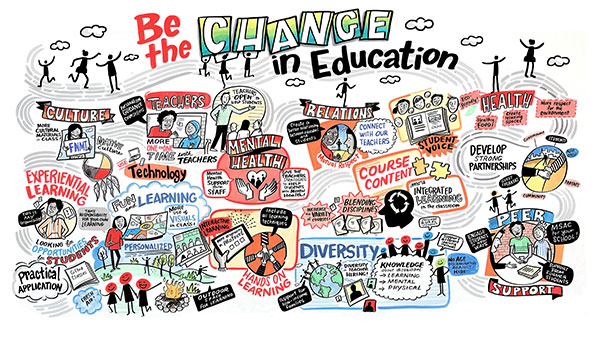
2018_be_the_change_small_en
Student X reads more books in a week than most adults do in a year.  He’s read Sapiens, Homo Deus , Superintelligence , Breakfast of Champions, Einstein: His Life & Universe, The Odyssey, The Stranger, Personal Power Through Awareness, Vagabonding and Thinking Fast and Slow in the past year just to name a few.  Everyday he enlightens us with something new that he has learned.  He has taught me and his classmates so much about so many different topics, he has lent me his books (I have only got through one of them) and he constantly makes connections to course material,  and get this,  in conversation with him he tells me that, “I have never felt smart in school”…..WHAT??
Meet Cameron Lamoureux, a grade 12 student who I have had the opportunity to coach and teach over the last three years.  In the first two years that I knew him, Cam’s teachers (including myself) would describe him as a very smart, and capable student who was not working to his full potential.  Cam is an extremely intelligent and insightful young man.  Below is a video interview and a post from his blog camlam.blog where he shares his views on our current system.  If this doesn’t get you to think twice about our need to unlearn, I’m not sure what will.


Learning to Learn

From the moment we start school, we are taught to play. There is certainly a lot of benefit to play. Although, the older we become the less we do it, we lose connection with our own interests and become distracted by material factors such as money or a new promotion. Our minds and bodies become less of a priority while we focus on larger goals for the well-being of others.

All of this playing teaches us something extremely valuable that traditional education does not. It teaches us to learn the way that we do best. Whether that be with our eyes, hands or ears.  Don’t get me wrong, I love standardized testing as much as the next guy. However, I am a firm believer in the power that each and every one of us possess to create change and add value to our world. Our everyday experiences are what make up our lives and in order to create the most meaning within those moments we must learn how we learn. Not as a society. As a human being. What is the best way for you to intake information. How do you learn? What factors contribute to your knowledge? These are questions that traditional schooling never answers. We are given a foundation of knowledge to memorize and regurgitate. The majority won’t even be given the opportunity to look inwardly for answers. Others may fall behind and give up on the learning process completely. Learning how to teach yourself any information  you desire to learn is a priceless tool that most people will never truly master or take advantage of. All because we are shrouded from the answers throughout our childhood. As I stroll through my path down the traditional school system, I’ve come to realize a lot. We are definitely not given all the answers, despite the fact that we occasionally think we’ve memorized them all. The only answer we need is in the questions.

CamLam

You can visit and follow Cam’s blog on mindfulness, learning and productivity at camlam.blog, you won’t be disappointed.

Thanks for reading 🙂

R

Citations

Image

“Student Voice.” Ontario Ministry of Education, 22 Dec. 2017, http://www.edu.gov.on.ca/eng/students/speakup/preMSAC.html.

Posted in Why Unlearn?

Unlearn With Us

learn unlearn relearn

Unlearn With Us

Sir Ken Robinson, Peter Gamwell, Angela Duckworth, Alan November, Andy Miah, Adam Schoenbart, George Curous, A.J Juliani, Carol Dweck, Daniel Pink, Elon Musk and more recently Don Wettrick and Nate Green, and schools such as The Independent ProjectBlue Sky School here in Ottawa, The Met School Model and Iowa BIG to name a few, have all inspired me in one way or another that change in education needs to happen and that it is happening.  My journey of “unlearning” began the moment I watched Sir Ken Robinson’s TED Talk “Do Schools Kill Creativity?”.   I was hooked and continued to seek others in the educational field who have a similar message and I haven’t looked back since.  I started my unlearning journey and just had to take my students with me.  Unlearning is scary and can feel lonely at times.  Often times after teachers are introduced to the big ideas from someone like Sir Ken the general feeling is that it all sounds great, but HOW can we incorporate creativity into an allotted time period, with specific curriculum, all while preparing our students for postsecondary education?   My hope is that this blog will become a place where teachers and students can see the unlearning process.  I plan to share the successes and failures in our unlearning journey to hopefully help others take the risk and be a part of this educational crusade!!  

Please come and unlearn with us!

R

“I am always doing that which I cannot do, in order that I may learn how to do it.” — Pablo Picasso